A Quick Guide to Google’s New AI Agent

Date : November 10, 2026

The internet is slowly shifting from a human browsing platform to an AI agents browsing web

environment to navigate and operate. Although the industry continues to debate AI search visibility, name conventions such as SEO versus GEO, and strategies for being displayed in tools like ChatGPT, the reality is advancing well beyond mere passive discovery.

The emergence of Google’s WebMCP, AI agents , and the latest Google-Agent user agent signifies that this transition is no longer hypothetical, it is currently in progress. Google has officially detailed the operational mechanisms of these agents, encompassing their IP ranges and functionalities, underscoring their significance in facilitating AI-driven interactions online.

Initial indications from the Google Agent update 2026, showcases experimental AI agents integrated within Chrome, foretelling a trajectory towards a more autonomous, action-driven internet where AI not only informs decisions but also implements them. In the following article, we’ll be trying to understand how ai agents function and what google has in store for us.

Key differences Amongst AI agents, AI assistants, and bots?

AI agent AI assistant AI Bot
Purpose Executes tasks independently with a proactive approach Supports users in completing tasks Automates routine tasks or simple conversations
Capabilities Manages intricate, multi-phase processes, acquires knowledge progressively, and autonomously makes rulings Addresses inquiries, delivers information, executes fundamental tasks, and recommends subsequent actions while deferring decisions to the user Operates on predefined rules with limited learning and basic functionality
Interaction Goal-driven and proactive Reactive and request-based Trigger-based and reactive

How Do Google AI Agents Operate?

Specific instructions and descriptions of available tools are provided by each Google AI agent, which also defines its function, personality, and communication style.

1. Persona

A clearly delineated persona allows an agent to maintain a coherent character and act appropriately according to its designated role, adapting as the agent engages with its environment and acquires experience.

2. Memory

Most agents tend to possess episodic long-term, and short-term memory. Using past discussions, recalling specific experiences, learning over time, and keeping context during encounters allows them to adapt and improve.

3. Tools

Ai agents interact with their environment by employing external tools and systems. These tools allow them to access information, process data, and execute actions, thereby enabling them to manage more intricate, multi-step duties that extend beyond basic responses.

4. Model

AI agents are constructed on the basis of large language models (LLMs), which enable them to comprehend, act, and reason. LLMs function as the “brain” of an agent, as they enable it to comprehend and generate language, while other components facilitate reason and action.

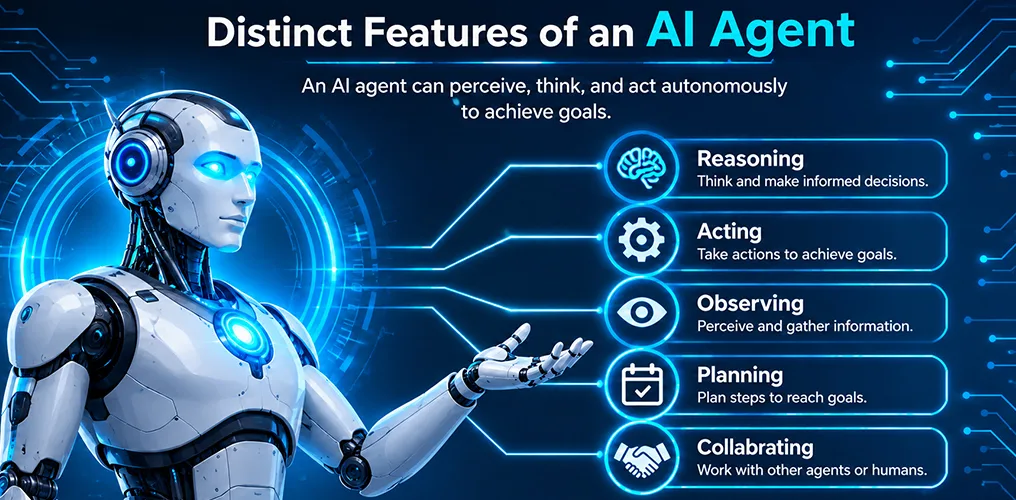
Distinct Features of an AI Agent

1. Reasoning

Data analysis, trend recognition, and the ability to make intelligent decisions based on facts and context are all capabilities of advanced AI agents.

2. Acting

AI agents need to be able to observe or sense their surroundings in order to comprehend and form opinions. They can perform digital acts like sharing messages, changing data, and starting operations.

3. Observing

AI agents must perceive or sense their surroundings to understand and make judgments. Google-Agent crawler usually resorts to computer based analysis, natural language processing, or sensor data analysis.

4. Planning

The most effective planning AI agents can assess the situation, weigh the options, and choose the one that will get them closer to their goals. Planning oriented AI agent’s day to day tasks involve forecasting and risk assessment.

5. Collabrating

Working collaboratively to achieve a goal is more important in complex and dynamic areas, whether with people or AI. Coordination, communication, and respecting others’ opinions are needed for collaboration.

6. Self-refining

Advanced AI adapts and improves. Self-refining AI agents can learn, adapt, and improve. It may involve machine learning, agent-based search optimization, or self-modification.

Google's Most Recent Advancements in the Field of AI Agents

Google is creating an AI agent ecosystem with enterprise-ready apps and flexible development tools. Businesses may develop, tweak, and scale pre-built agents across workflows and systems using this technique.

1. Gemini Enterprise Agent Platform

This platform supports no-code (natural language) and code-first AI agent and application development. It anchors agents in enterprise data, improving decision-making precision and relevance.

2. Customer Experience Agent Platform

This conversational AI tool helps create hybrid agents with deterministic (rule-based) reasoning and generative AI. This makes it suitable for complex customer journeys and answer oversight.

3. Agent Garden

A carefully curated collection of agent templates, tools, and frameworks for faster development. It speeds up AI system prototyping and implementation by using pre-fabricated components.

4. ADK: Agent Development Kit

Open-source Python SDK for complex multi-agent systems. It includes orchestration, memory management, and developer tools for advanced and coordinated agent activities.

5. A2A Protocol

A transparent design that ensures agent-platform interoperability. It helps AI agents collaborate across services, improving their flexibility and scalability in practice.

Use Cases for AI Agents

AI agents are being deployed across major corporate areas to automate operations and enhance efficiency. These can be categorized into six use cases:

1. Customer Agents

 Deliver personalized experiences by answering queries, resolving issues, and recommending products across web, mobile, and in-store channels.

2. Employee Agents

 Automate routine tasks, answer internal questions, and help with content development and communication to boost productivity.

3. Creative Agents

 Support design and marketing by generating content, ideas, and visuals for campaigns and personalization.

4. Data Agents

 Analyze large data sets for insights, reporting and decision making.

5. Code Agents

Assist in software development through code generation, debugging, and learning new codebases.

6. Security Agents

 Enhance security by detecting threats, preventing attacks, and enabling faster response across the security lifecycle.

Conclusion

As agents drive the internet, machines are retrieving and acting on people’s behalf. Based on Google’s trajectory, the future of AI search agents forecasts that AI bots will navigate, assess, perform AI-driven web navigation and carry out repetitive manual jobs across digital platforms. This transformation goes beyond search, making the web more interactive with google-agent seo impact.

Agentic Search Optimization (ASO) adds a layer to SEO, making your brand transparent, reliable, and actionable for automated systems. As Google-Agent and agent-led interactions become more common, companies that adapt quickly will be better positioned when AI informs and executes decisions.