AI in Reputation Management: Trends, Strategies & Impact

Date : October 22, 2026

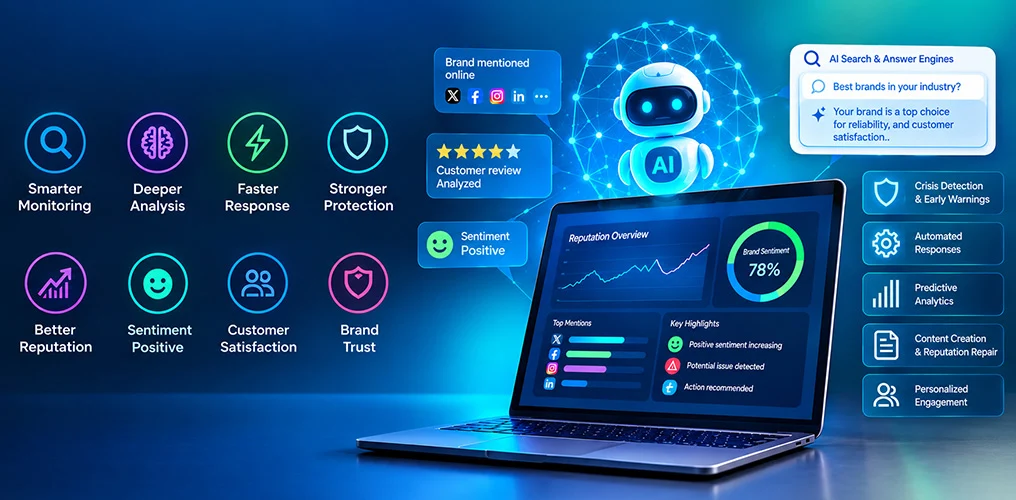
Reputation management has become proactive, dynamic, and driven by artificial intelligence. Companies employ AI analytics to identify attitude changes promptly, avert problems, and oversee reputation on a large scale, facilitating expedited, data-driven decisions.

AI functions as an “agent co-pilot,” assisting in the analysis of user intent, directing interactions, and enhancing response quality through precise, evidence-based insights. In addition to reviews and social media posts, platforms such as Google AI Overviews, Microsoft Copilot, and ChatGPT now convert this information into concise summaries that influence initial perceptions.

Businesses must acknowledge the increasing significance of AI in reputation management and optimize accordingly to feature in these summaries.

How are AI summaries influencing first impressions of brands?

Artificial intelligence is transforming how brand perceptions are formed, often before any direct engagement, beyond just reviews, social media, blogs, or articles

  • AI tools like Google AI Overviews, ChatGPT, and Perplexity AI analyze content to generate concise summaries that shape first impressions, trust, and expectations
  • Customer ratings and feedback now play a bigger role as key inputs for these AI models
  • Brands must manage reviews consistently, respond thoughtfully, and maintain quality across platforms to influence how they are represented.
  • According to Bain & Company research, about 80% of search users rely on AI-generated summaries for at least 40% of their searches, while nearly 60% of searches on traditional engines now end without users clicking through to another destination.

How is AI changing Online reputation management (ORM)?

AI technologies are not new to reputation management platforms

AI and reputation management aren’t new partners, they’ve been working together quietly for years. Long before the recent wave of generative AI, machine learning was already embedded in local SEO and reputation strategies, helping brands make sense of customer feedback and respond more efficiently.

Back then, AI worked behind the scenes. It analyzed reviews, identified sentiment patterns, and highlighted the factors influencing customer perception through key driver analysis. It helped businesses classify feedback more accurately and respond faster with consistent, on-brand messaging. Useful, yes, but largely foundational.

What’s changed now is the scale and influence. With the evolution of generative AI, those same capabilities haven’t just improved, they’ve become far more visible and impactful. AI is no longer just interpreting reputation; it’s actively shaping how brands are perceived, summarizing feedback, and influencing first impressions in real time.

Latest Advancements in AI Reputation Management

Reputation management has evolved well beyond merely monitoring reviews and addressing grievances. With the emergence of generative AI, enterprises are now capable of forecasting, influencing, and molding brand perception instantaneously. The emphasis has shifted from damage repair to proactively managing your brand’s perception on AI-driven platforms and summaries.

  • AI Reputation Manager (ARM): Uses real-time AI-powered Review management software that keeps an eye on AI-driven sentiment analysis, uncover outside threats, and find new problems before they get worse. This way, teams can do something before situations actually get worse.
  • Voice of Brand (VoB): Constantly scans and reviews what customers say to make sure that the tone, message, and sentiment are all in line with brand rules. This keeps things consistent across all touchpoints.
  • AI-Powered Competitive Intelligence: Analyzes competitors day to day reputation management activities and compares performance of brand and local competitor levels.
  • Real-Time Sentiment and Trend Analysis: This tool lets you know how customers feel about your business and how that changes over time, so you can act more quickly and with more information.
  • Predictive Reputation Analytics: AI now identifies early warning signals by analyzing patterns in reviews, customer behavior, and engagement trends. This enables brands to anticipate risks and act before negative sentiment escalates into larger reputation issues.
  • Highly Customized Reputation Management: AI-driven systems personalize responses and engagement based on individual customer sentiment and history. This shifts interactions from generic replies to context-aware communication that builds stronger trust and influences perception.
  • AI-Centric Data Integration: Modern platforms unify data from reviews, social media, listings, and third-party sources into a single intelligence layer. This gives brands a holistic, real-time view, enabling faster and more coordinated decision-making.
  • Cross-Platform Reputation Mapping: AI connects conversations across reviews, social media, forums, and more to create a complete view of brand perception. This helps businesses respond with full context instead of fragmented insights.
  • AI-Driven Trust & Authenticity Analysis: AI evaluates tone, transparency, and consistency across interactions to measure how authentic a brand appears. These insights help refine communication and align with evolving consumer trust expectations.

Understanding the influence of AI in Reputation Management

AI is no longer just a support tool in reputation management, it’s becoming the backbone of how brands monitor, manage, and influence perception at scale. From improving team efficiency to preventing crises and shaping future visibility, AI is transforming reputation management into a faster, smarter, and more proactive function.

Leaner Teams For Smarter Workflows

By automating review tracking, sentiment analysis, and response generation, AI reduces dependency on large teams. This allows smaller teams to efficiently manage multiple platforms while maintaining consistency and responsiveness.

Proactive Risk Management

Continuous monitoring of reviews, social media, and online conversations helps identify early signs of dissatisfaction. Brands can respond quickly and prevent minor concerns from turning into major reputational issues.

AI Shaping Brand Visibility

Reviews, ratings, and online sentiment are now key factors influencing how brands appear across AI-driven search experiences. The way a brand is discussed online directly impacts customer perception and discoverability.

Human + AI Balance

While AI improves speed, scalability, and efficiency, human oversight remains essential for strategic thinking and handling sensitive situations. The strongest reputation strategies combine technology with human judgment.

SEO in the Age of AI

Search engines are increasingly prioritizing content quality, credibility, and reputation signals over traditional keyword-focused SEO tactics. Brands with strong online trust and authentic content are more likely to gain visibility.

Final Thoughts

We anticipate a surge in robust AI-driven functionalities in reputation management. This encompasses brand monitoring technologies designed to enhance visibility in generative search results, such as Google’s AI Overviews. AI-driven business intelligence will also gradually incorporate reputation data into core decision-making, enabling teams to work faster and plan more effectively.

These skills will be crucial for managing corporate perception, competitive search, and market fluctuations as they improve. Quickly adopting AI will help companies interpret reputation data, coordinate teams, and remain ahead of the competition while meeting changing customer expectations.