6 Strategies to Dominate AI Search

Date : October 6, 2026

People’s shopping habits have changed a lot in the last few years. AI-powered systems are moving beyond just answering questions to replacing human decision-making in many cases. Instead of going through pages of results, users can ask direct questions and get instant answers. These responses are driven by signals like accuracy, consistency, reviews, engagement, and overall online reputation—not random selection.

AI doesn’t just show options; it sorts, ranks, and recommends the best ones. It acts as a gatekeeper, allowing only businesses that meet its criteria to be visible. This shifts how visibility works, traditional SEO alone isn’t enough. Businesses now need AI search optimization and AI interpretation to maintain strong reputation signals, consistent presence, and accurate data.

Brands that align themselves with how AI evaluates and makes recommendations can gain more visibility, clicks, and sales. Those with weak or inconsistent signals risk becoming invisible, regardless of past rankings. The shift from “searching” to “asking” is changing discovery—being recommended, not just found, now drives business growth.

Criteria Employed by AI Systems for Business Recommendations

AI algorithms do not merely rank websites. They examine data available on the internet and produce responses and summary based suggestions. This aids AI systems in determining which businesses to highlight to the users. These systems assess indicators of credibility and trust, including:

  • The evaluations and assessments of the customers
  • Ensuring that listings are accurate across all directories and maps
  • The evaluations of the client and their emotional reaction
  • External sources that can be trusted
  • Detailed and consistent information regarding the business world
  • Enterprises exhibiting robust Trust signals for AI systems are more prone to being identified, endorsed, and selected by consumers.

Reputation management has transitioned from a marketing role to a fundamental data layer that influences AI systems’ perceptions of your organization.

Six Ways to Strengthen the Signals AI Actually Uses

AI doesn’t judge your business based on your website alone, it looks at your entire digital presence. From reviews and listings to third-party mentions, everything contributes to how AI systems understand and recommend your brand. Here’s how to strengthen those signals in a practical, human way:

1. Build Credibility Beyond Your Website

Artificial intelligence places greater reliance in external perceptions of you than in your self-representations. References from credible sources enhance the credibility of your business.

Plan Of Action:

  • Promote your name in esteemed publications or industry-specific websites.
  • Continue to receive positive evaluations on reputable platforms.
  • Get other people to talk about or mention your brand.
  • Pay attention to how your business looks on other websites.

Note: In the current world scenario, the absence of external validation costs businesses dearly as it becomes more challenging for AI to see your business as credible.

2. Customer Reviews

One of the best ways to tell if you can trust anything is by reading reviews. AI will verify the number of reviews you have, how recently they were added, and what people have to say in them.

Feasible Measures you can take:

  • Get happy consumers to write reviews.
  • Always try to obtain reviews on a regular basis, not just once in a while.
  • Responding to feedback shows that you care and are involved.
  • Track sentiment to spot issues early

Note: Having evaluations that are either out of current or inconsistent sends weak signals about your company.

3. Keep Your Business Information Accurate Everywhere

Artificial intelligence cross verifies your company’s information across many different platforms. Inaccurate information or discrepancies engender skepticism and raise doubts.

Feasible Measures you can take:

  • Keep your name, address, and phone number consistent
  • Update hours, services, and contact details regularly
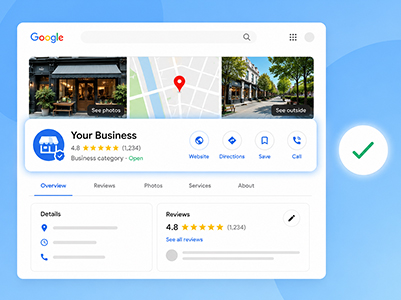
  • Complete your profiles on maps and listing platforms
  • Fix duplicates or incorrect listings quickly

Note: Minor errors and irregularities can significantly hinder the establishment of customer confidence and visibility in AI search results.

4. Clearly Listing Out What You Exactly Have To Offer

AI requires substantial information about your activities to determine your actions. A lack of clarity in your message may lead to misunderstandings or erroneous interpretations.

Feasible Measures you can take:

  • Be clear about what your goods and services are.
  • Use detailed information, including dates, figures, and results.
  • Stay away from vague or fluffy marketing language
  • Be upfront about limitations or conditions

Note: The clearer your content, the better AI can represent your business to others.

5. Make Your Content Easy to Read and Extract

Artificial Intelligence favors structured, easily navigable content. Disordered pages tend to hide significant information.

Feasible Measures you can take:

  • Use clear headers and subheads.
  • Divide stuff into digestible chunks.
  • When useful, use bullet points or tables.
  • Page formats should be consistent.

Note: Good structure makes it easier for AI to pick up and use your information.

6. Don’t Ignore Technical SEO

Things may be changing, but the basic fundamental elements still count. No matter how seamless your content is, if your technical SEO is weak, AI and search engines may have a hard time correctly accessing, understanding, or displaying your site. 

Feasible Measures you can take:

  • Make sure that your website loads quickly on all devices.
  • Make it easy and sensible to get around
  • When you can, use structured data (schema).
  • Check to see if your pages can be crawled.

Note: If your technical setup isn’t strong, it can make it harder for people to find your firm, initially resulting in lost customer potential.

Simplifying Reputation Management For The AI Era

Overseeing the signals that affect AI-powered discovery and AI-driven customer acquisition is challenging, particularly for enterprises operating across several locations, platforms, and consumer interactions. Maintaining consistency, currency, and responsiveness at scale can rapidly become daunting.

That’s where platforms like Vicinus come in.

Designed to streamline Reputation management for AI search, Vicinus consolidates essential components, helping organizations enhance the specific signals AI systems use for recommendations.

  • Keep business information accurate and consistent across GMB and other directories.
  • Use AI based responses for customer reviews in a customised way.
  • Generate more true, keyword rich reviews through QR based AI review booster.
  • Transform consumer feedback into actionable information to improve customer experience through sentiment analysis.
  • Track online reputation indicators to promptly detect risks and opportunities for AI visibility for businesses.
  • Check for own and competitor ranking in high performing keywords from various points within a catchment – keyword rank tracking
  • Get an overview of the KPIs, listing health, review responses and analytics from a central dashboard
Reputation Management Area Key Action AI-Powered Benefit Business Impact
Directory & Listing Alignment Maintain accurate, consistent business info (NAP) across Google Business Profile and global directories. Prevents data discrepancies and automatically syncs updates across LLMs and search engines. Boosts local map pack rankings, builds AI search trust, and drives higher high-intent foot traffic.
Review Response Automation Implement customized, context-aware AI responses to incoming customer reviews in real time. Generates tailored, brand-aligned replies at scale while seamlessly incorporating key local search phrases. Elevates customer satisfaction, enhances brand credibility, and signals high responsiveness to search algorithms.
Review Acquisition Strategy Deploy QR-based AI review boosters at key physical and digital customer touchpoints. Guides satisfied customers to easily share authentic, keyword-rich feedback tailored to their specific experience. Increases review volume and star ratings, significantly strengthening recommendation odds in AI search engines.
Sentiment Analysis & Insights Perform continuous AI sentiment analysis on customer feedback across all public review channels. Automatically detects emotional tone, identifies operational bottlenecks, and uncovers emerging customer trends. Enables rapid service enhancements, reduces customer churn, and directly improves overall customer experience (CX).
AI Visibility & Risk Monitoring Monitor digital reputation indicators across search engines and generative AI platforms. Audits brand representation in real time across LLMs (e.g., ChatGPT, Gemini, Perplexity) to flag misalignments. Protects brand reputation, mitigates PR risks, and secures top recommendations in AI-generated search results.
Competitive Local Tracking Track hyper-local keyword rankings for your business and competitors across defined catchment radii. Delivers predictive rank insights and detects localized keyword gaps at the zip code or neighborhood level. Outperforms regional competitors, captures localized market share, and optimizes geotargeted marketing ROI.
Centralized Performance Governance Aggregate listing health, review engagement, competitive benchmarks, and KPI analytics into one dashboard. Synthesizes multi-location data into visual trends, real-time alerts, and automated strategic recommendations. Streamlines executive decision-making, reduces management overhead, and ensures measurable marketing impact.

By consolidating all of this in a single location, enterprises establish a transparent and reliable digital presence, enabling AI systems to recognize, trust, and endorse them at critical moments.

Final Thoughts

Artificial intelligence is changing how businesses gain visibility and which ones get selected. Brands that appear in AI-generated responses usually have the strongest trust signals online.

This benefits companies that actively manage their reputation. Consistent ratings, accurate listings, positive reviews, and credible third-party mentions all boost visibility at key decision moments. This directly impacts revenue, as being recommended when a customer is ready to choose increases conversion chances

Weak or inconsistent signals can make your business invisible in AI-powered discovery. Even strong products or services won’t matter if AI lacks confidence in your brand. In this environment, reputation doesn’t just shape perception, it determines visibility and drives customer acquisition and growth.