Business Directories
Directory submissions were once a slow SEO chore, but today AI assistants pull location data directly from these aggregator networks. An outdated directory listing quietly eliminates your business from AI recommendations before a customer ever finds you.

Find top networks in our guide to Free Business Listing Sites
Centralize your strategy on our Local Listing Management hub.
From Slow Citation Coverage to Real-Time AI Syndication
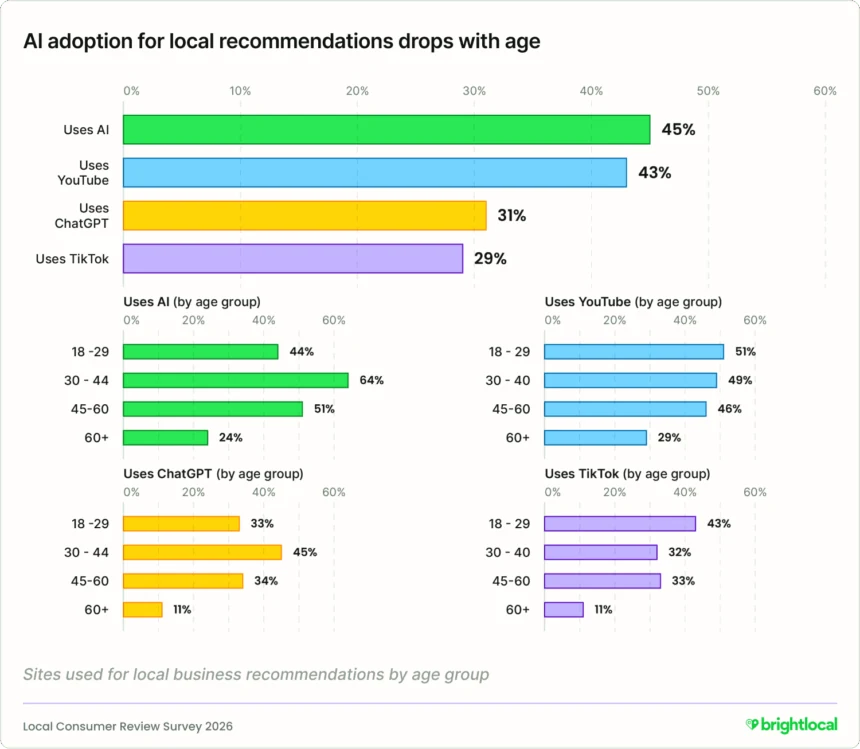
45% of consumers used AI for local-business recommendations in 2026. As AI becomes part of local discovery, organizations need governed, structured business data that can be distributed and updated through their key listing platforms and data partners.
The Model Shift
Historical directory management relied on passive propagation over weeks; modern syndication pushes live updates directly via API to high-impact online business directories.
Direct AI Sourcing
Conversational search platforms rely on specific directory partners. ChatGPT pulls heavily from Foursquare and Bing, Gemini draws from Google Business Profile, and Yelp feeds multiple AI discovery engines.
Accuracy Equals Visibility
For business listings by AI assistants, data inconsistencies across directory networks directly lead to drops in AI recommendations or hallucinated store details.
Real-Time Data Freshness
Legacy citation building took weeks to reflect changes. API syndication instantly pushes holiday hours, temporary closures, and service updates so AI engines never surface stale operational info.
Multi-Source Consensus
AI models cross-verify listings across multiple networks before answering. Uniform data across all major aggregators builds the entity confidence needed to rank in generative search results.
Semantic Attribute Matching
Conversational prompts demand more than basic NAP. Syndicating rich metadata (amenities, payment methods, accessibility) allows AI agents to match complex natural-language searches.
Directories that Still Matter in 2026





For a curated breakdown of free submission platforms across industries, see our guide to Free Business Listing Sites.
The 3-Tier Directory Ecosystem: How Business Data Flows to Search & AI
A 2025 study reported that 58% of consumers began local-business research in a traditional search engine, 14% in a maps app, 11% through voice assistants, and 8% with an AI tool.
Modern directory management is not about submitting to thousands of low-quality sites; it is about governing the three distinct data layers that search engines, GPS navigation networks, and AI assistants use to verify local businesses. Understanding how information moves between primary map profiles, wholesale aggregators, and vertical hubs prevents listing drift and ensures full-coverage AI grounding.
| Ecosystem Tier |
Core Platforms
|
Primary Role
|
AI & Local Search Impact
|
|---|---|---|---|
| Tier 1: Primary Search & Map Networks | Google Business Profile, Apple Business Connect, Bing Places | Direct consumer discovery surfaces, in-app navigation, and native voice search | Serves as the primary ground-truth anchor for Gemini, Siri, and Copilot/ChatGPT. |
| Tier 2: Core Data Aggregators | Data Axle, Foursquare, Neustar Localeze | Wholesale data distributors that syndicate verified NAP to hundreds of downstream directories, apps, and telematics | Wholesale data distributors that syndicate verified NAP to hundreds of downstream directories, apps, and telematics |
| Tier 3: Vertical & High-Intent Portals | Yelp, Tripadvisor, Healthgrades, AngiRelevance, Distance, Prominence | Niche authority hubs capturing high-intent category searches and unstructured consumer reviews | Provides customer sentiment and niche service attributes that AI models evaluate for conversational ranking. |