Today, user search intent is a more significant factor than the literal keywords used in a query. AI systems like Google SGE, Bing Copilot, Perplexity, and ChatGPT Search are changing the way people search online. They understand the context instead of just matching keywords, delivering fast and accurate answers. Users now rely on voice queries, visual searches, and conversational questions, expecting clear and reliable results. To meet this, businesses must make their websites easy to find, simple to use, and aligned with how people naturally search and interact online.
For small businesses, adapting to AI-driven search is no longer optional – it’s essential. AI decides which businesses appear in answer boxes, summaries, and suggestion lists, sometimes before users even click a link.
Having accurate, organized, and AI-ready content, strong local signals, and plenty of reviews helps small businesses compete with larger companies. By optimizing content and listings to match how AI interprets search intent, small firms can increase visibility, attract customers faster, and stay ahead in the evolving search landscape.
What Is AI Search Optimization?
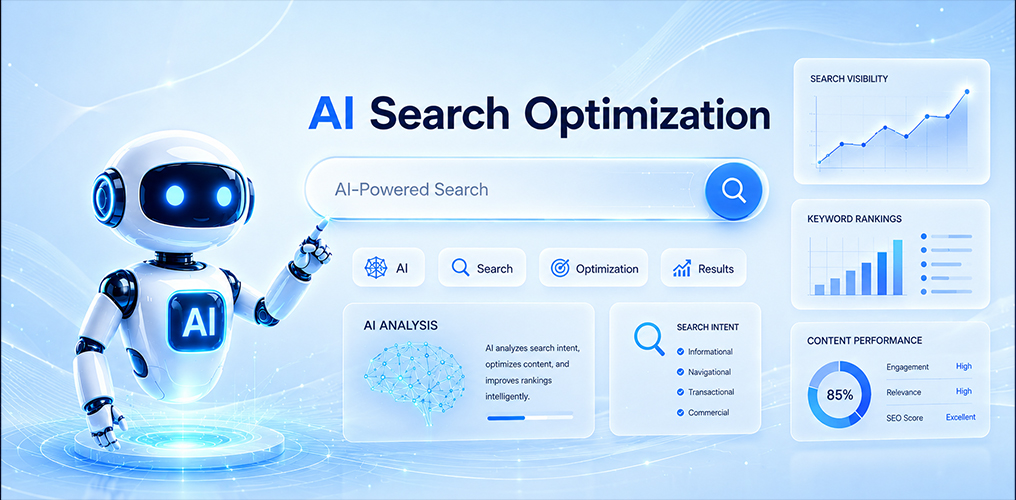
The goal of artificial intelligence search optimization is to improve the readability, comprehension, and visibility of your online content in search engine results (including answer summaries, suggestions, and conversational results) and also from users’ perspective.It’s like getting your website ready for a better search engine. This search engine can understand normal language, read context, guess what the user wants, and show them the best results. You need AI local search Optimization if you want your website to show up in the more and more replies made by AI.
Traditional SEO vs. AI-Driven SEO
Keyword-focused
Intent- and context-focused
Enhances search result pages
Enhances AI response boxes, synopses, and dialogue outputs
Dependent on local backlinks, citations, schema markup for local business, hyperlocal SEO and metadata
Dependent on clarity, structure, trust signals, and real-world relevance
Operates on precise match words
Comprehends natural language inquiries
The majority of ranking variables are static
Continuously and dynamically updating their outcomes in real time, AI models
How AI Search Engines Influence Rankings?
Search engines like Google SGE, Bing Copilot, Perplexity, and ChatGPT Search obtain information from several websites and then look at:
How well your content answers questions
If your information is correct, well-organized, and current
How reliable your business seems (reviews, consistency, authority)
Not simply keywords, but also whether your content matches what the user wants
Overall usefulness for quick summary answers
AI search no longer ranks 10 blue links. Instead, it picks a few sources to generate its answer. No matter how well you did in traditional search, your content won’t be picked if it’s not optimized for AI now.
Role of AI in Google Business Profiles
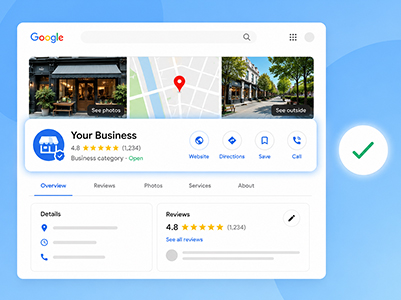
Your Google Business Profile (GBP) is your storefront on Search and Maps for most local buyers. AI affects how profiles are managed and rated, therefore correctness, activity, and optimization are crucial. Google and third-party platforms use AI to handle, improve, and protect business listings. This is what “Google Business Profile AI” refers to.
1. Real-time Information Updates
Google’s AI frequently recommends modifications—such as adjusted business hours—derived from popular-times statistics, Street View imagery, and patterns from analogous listings. Active local SEO audit is important. Third-party AI technologies provide the rapid tracking of updates, alarms, and errors, surpassing the efficiency of manual verification.
2. AI-Generated Descriptions and Posts
Google is experimenting with generative AI to compose business descriptions and Google Posts. AI platforms also provide automated content recommendations. These can expedite updates; however, human editing is essential to ensure messaging is correct, consistent with the brand, and compliant.
3. Review Evaluation and Apt Response Creation
Reviews strongly influence local rankings and consumer trust. AI tools can assess sentiment in several reviews, identify persistent problems, and provide answer templates. This enables businesses to reply more swiftly while comprehending necessary operational enhancements.
4. Optimization of Questions and Answers
The GBP Q&A segment is frequently disregarded. AI can figure out what questions customers usually have about your business or your rivals’ businesses and help you come up with proactive, search-engine-optimized answers. This makes AI-driven search results more clear and encourages more participation.
5. Combatting Counterfeit Profiles and Evaluations
When Google finds fake entries, questionable changes, or misleading reviews, it uses artificial intelligence to find them.
Vicinus brings all these AI features into one platform, making local listing management easier. It monitors your profiles in real time, alerts you to unwanted changes, and offers AI suggestions for posts, descriptions, and local updates. Its review intelligence analyses customer sentiment, improves your GBP Q&A with SEO-friendly answers, and protects your listings by detecting fraudulent edits or suspicious activity.
AI-Driven SEO Tips
1. Strengthen Conversational Queries
Focus on natural-language keyword research that mirrors how customers actually speak.
Build content around real questions, phrases, and problem statements users search for.
Include detailed FAQ sections to increase visibility in conversational and AI-driven search results.
2. Make Content Easy for AI to Interpret
Keep your structure clean with clear headings, short paragraphs, and bullet points.
Add definitions, summaries, and concise explanations to help AI extract key information.
Make your content skimmable so AI systems can pull answers for snippets and quick views.
3. Improve Local SEO Signals
Ensure your Google and Bing Business Profiles are fully completed, regularly updated, and optimized.
Maintain strict NAP consistency across all directories and listings.
Use AI tools to refine citations, analyze review patterns, and strengthen local relevance for search queries.
4. Use AI for Smarter Keyword & Topic Research
Leverage AI tools to categorize keywords, uncover search trends, and detect seasonal patterns.
Analyze competitor strategy to reveal content gaps and new ranking opportunities.
Prioritize intent-focused keywords that match what your audience truly wants.
5. Create High-Quality Content With AI Assistance
Use AI for outlining, data gathering, and ideation—then refine with human insight.
Add expertise, real examples, case studies, and unique data to stand out from generic AI content.
Maintain originality and depth to improve ranking signals across AI search systems.
6. Optimize for AI Overviews & Featured Snippets
Provide short, clear, and direct answers to commonly asked queries.
Use AI insights to regularly refine your Google Business Profile and local content.
Explore predictive SEO opportunities to stay ahead of emerging industry trends.
7. Strengthen Visual Search Optimization
Upload high-quality images with accurate filenames, ALT text, and structured metadata.
Optimize product, service, and location images to improve ranking in AI-powered visual search.
Ensure images match search intent to increase clicks and visibility.
8. Enhance Review Signals Using AI
Encourage consistent reviews on Google, Yelp, and relevant industry platforms.
Use AI sentiment analysis to understand customer emotions and recurring themes.
Respond quickly and professionally to improve trust, credibility, and local SEO strength.
Top AI Tools Every Small Business Should Use
1. Ai Tools For Keyword Research
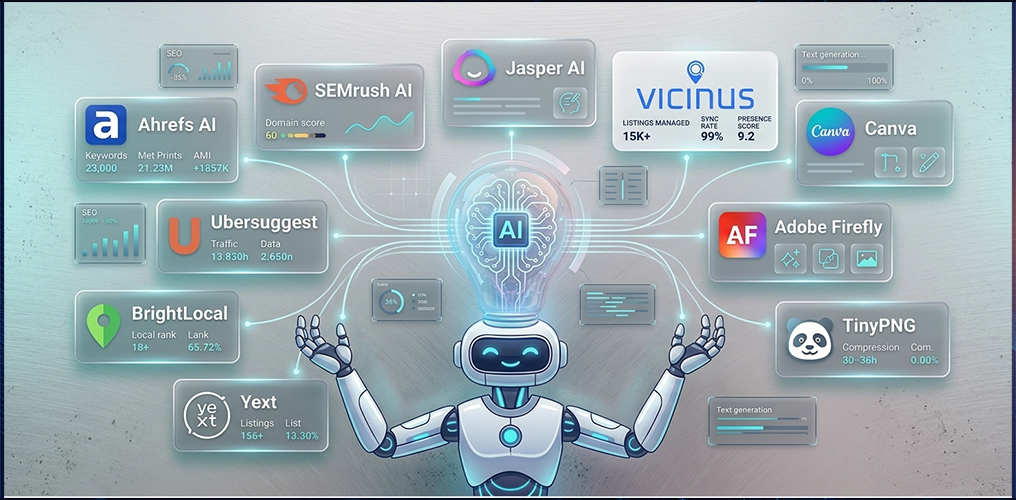
Ahrefs AI: Shares AI-powered keyword suggestions and competitor data.
SEMrush AI: Real-time overview into trending keywords.
Ubersuggest: Provides AI Base Keyword.
2. Ai Tools For Writing
Jasper AI: Makes blog posts, social media posts, and ads.
Copy.ai: Quickly make content and templates with AI
Writesonic: Generates SEO based content.
3. Ai Tools For Automating Local Seo
BrightLocal: Managing listings, doing local audits, and keeping track of citations.
Whitespark: Helps with local search and establishing citations.
Vicinus: Keeps track of and refreshes location listings automatically.
4. Ai Tools For Monitoring Reviews And Analyzing Sentiment
Vicinus: Also seamlessly gathers and handles reviews.
Yext: Lets you keep track of reviews on more than one platform.
Reputation.com: Gives you AI-powered sentiment analysis and warnings.
5. Ai Tools For Image Optimization
Canva: Allows you to design and enhance images.
TinyPNG: Makes image compression easy.
Adobe Firefly: Visual enhancement.
How Vicinus Enhances AI-Powered Search Optimization
Small enterprises can efficiently enhance their search visibility with AI-driven tools such as Vicinus. The geo-targeted content recommendations feature helps enhance local visibility and high rank in pertinent searches. It also offers AI-generated insights into customer reviews and keywords to enhance performance. Additionally, Vicinus automates listing processes , so that all your locations remain consistent across several platforms.
Case Study: How AI Optimization Boosted Dr. Smith Dental’s Local Search Visibility
Situated in Charlotte, North Carolina, Dr. Smith’s Dental Clinic offers general dentistry services. Since its inception eight years ago, the clinic has grown to serve nearby dwelling families and individuals providing them with general dental care, cosmetic procedures, emergency services, and preventative programs. However, the clinic relies heavily on word-of-mouth, referrals and repeat appointments earned through quality care and patient trust.
Digital Growth Barriers
Despite its strong offline presence, the clinic struggled to remain visible in an increasingly competitive digital environment. Key issues included:
Low Online Visibility: The clinic’s website ranks poorly amongst high-intent local searches like “dentist near me” and “emergency dentist Charlotte.” At times, the clinic didn’t even appear on the first page of search engine results.
Weak Google Business Profile Performance: Due to its inefficient GBP optimization, only a few patients were able to discover the clinic through Google Maps or local search results.
Minimal Website Traffic: Restricted organic reach resulted in fewer opportunities to attract new patients and grow the clinic’s customer base.
Competition From Digitally Proficient Clinics: Multi-location dental chains and newer clinics with aggressive online marketing strategies were consistently outperforming Dr. Smith’s practice.
Intended Goals & Aspirations
Local Search Visibility: Rank higher for key terms like “dentist near me” and “emergency dentist Charlotte.”
Website Traffic: Increase visitor engagement to educate them about services and the clinic.
Online Appointments: Increase the volume of patients scheduling appointments via the website.
AI Strategies Implemented
The clinic utilized AI in many marketing domains to improve search visibility and increase patient interaction. The AI techniques used to achieve desired results are as follows:
SEO Audit & Keywords: Artificial Intelligence assessed trends, competition, and search behavior to pinpoint high-impact local keywords.
Content Strategy: AI-recommended blog subjects and enhanced service pages for localized queries.
Local SEO Optimization: Artificial Intelligence enhanced Google Business Profile, directories, and facilitated patient reviews using chatbots.
Real-Time Tracking and Predictive SEO: AI tracked performance everyday and forecasted patterns to generate timely, high-performing content.
Impact & Results
After 60 days, the clinic saw significant gains in rankings, traffic, GBP views, and appointment bookings.
Keyword Rankings: Keywords in the top 10 rose from 6 to 18. High-intent searches like:
“Emergency dentist Charlotte NC” (#2)
“Teeth whitening near me” (#4)
“Dental cleaning Charlotte” (#3) drove more targeted traffic to the website.
Website Traffic: Monthly visits increased from 80 to 2,300, showing higher online visibility and more patient interest.
Google Business Profile Views: Views jumped from 520 to 3,800, improving local discoverability and connecting the clinic with nearby patients.
Online Appointments: Monthly bookings grew from 8 to 42, turning online visibility into real patient visits and revenue.
By integrating AI insights with human supervision, the AI-driven approach not only increased transparency but also converted digital development into successful measurable business outcomes.
Final Thoughts
Incorporating AI into local SEO presents an effective opportunity into the future of effective digital marketing for small businesses. AI can help you manage your Google Business Profile, understand hyper-local search meaning, and predict industry trends using predictive SEO data. This makes your business more visible and gets more local customers interested.
By adding AI SEO to their small company plans, companies can go beyond traditional tactics and run really targeted, data-driven campaigns. You may make your online store more appealing and accurate by using the AI features and insights of Google Business Profile. Looking at advanced local SEO strategies that small businesses might use with AI help gives them a big advantage over their competitors.