Hyper-Local SEO in the Age of AI: Mastering Google’s 2025 Algorithms
Date : May 20, 2026
Share
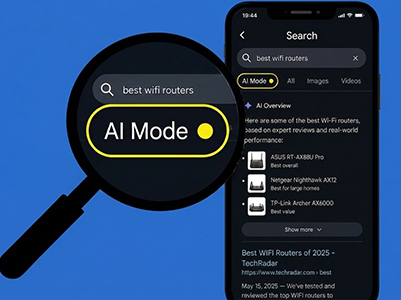
Google’s new local search algorithm is altering how brands show up online. With the deployment of Google AI Deep Dive mode, local discovery now relies more on reputation signals than traditional keywords. This move began with two significant updates: the June 2025 fundamental improvements and the July 9 debut of Google’s AI-powered search experience, followed by an official confirmation a week later that advanced AI capabilities would henceforth influence how results are created.
As per Business Today, a study of 900 US adults in March 2025 analyzing 68,879 Google searches found that 18% displayed an AI Overview (AIO); when an AIO appeared, users clicked traditional search result links only 8% of the time, versus 15% click-through on searches without an AIO. This indicates that AIOs often reduce the likelihood of users clicking through to external websites because the AI generated summaries may be satisfying user queries more directly, leaving little to be explored through external content.
Google’s AI Upgrade That Local Marketers Can’t Ignore
Google added a new AI-powered mode to AI Overviews on July 9. On July 16, it confirmed the path with an online piece called “More Advanced AI Capabilities Are Coming to Search.” Which clearly shows that Google is quickly moving toward a search experience that is centered around AI.
How To Use AI With The Current Google Mandates?
When customers type in “best coffee near me” or “affordable dog groomers in Denver,” the top of the results page now provides an AI Overviews (AIO) instead of just a list of links. This is the brief version:
Focuses on the best-rated businesses in the area
Links that go straight to their Google Business Profiles
Exhibits mean star ratings
AI now helps users explore more businesses by highlighting options based on reputation, ratings, and trust signals, often revealing brands they might have missed. Behind the scenes, search impressions may appear to drop simply because they’re shifting from traditional results to Google’s AI experience, where many interactions aren’t yet fully tracked.
Where Does Google’s AI Gather Its Information?
Google’s innovative AI-powered search experience compiles information from numerous reputable sources. They extract insights from:
High-authority webpages that Google identifies as reliable
Google’s Knowledge Graph with structured entity data
Schema.org markup that helps AI understand context
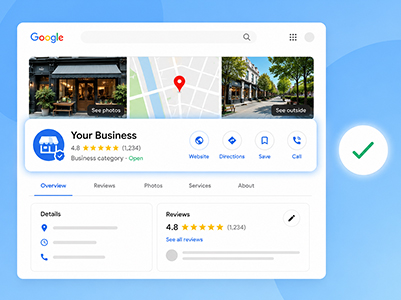
Google Maps and Google Business Profiles, including reviews and updates
Trusted local and industry directories with verified signals
AI doesn’t just read data, it interprets meaning and the intent behind online content. By analyzing context, sentiment, and consistency, it pieces everything together to create a quick, accurate summary that answers the user’s question.
This creates two major implications for local businesses:
Visibility No Longer Ensures Traffic: Your business might be highlighted in the AI Overview; yet, users may not navigate to your website.
Inconsistent Data May Make Your Business Unnoticeable: If your information varies across platforms, Google's AI may consider it unreliable and omit it from Overviews.
Current AI Priorities: Evaluations, Assessments, and Credibility
With this artificial intelligence-enhanced search experience, Google gives more weight to businesses that have strong content and reputation than it does to simple proximity or keyword optimization. Trust and feedback from customer reviews and responses have been the primary focus, not only on Google but also throughout the other websites on the internet.
Here are the sources from which Google’s AI derives its signals:
Google Business Profile reviews
Star ratings, 4.5 or higher
Assess review sentiment
Commercial websites with Google reviews
Companies that showcase Google reviews on their websites see real improvements. Google treats these pages as more trustworthy and credible, helping them rank better. In early tests, businesses with 4.9-star reputations show up most often, while lower-rated ones are pushed aside.
This transition transcends mere star ratings. It pertains to:
Caliber of evaluations
Uniformity of feedback
Confidence across several platforms
Google’s AI is scrutinizing customer utterances, including their commendations, grievances, linguistic patterns, and the frequency of their feedback submissions.Knowledge panels are undergoing transformations. They currently derive from:
Direct quotations from Google reviews
Customer reviews on platforms like Yelp and TripAdvisor
Integrated assessments on commercial platforms
Social metrics from Facebook and Instagram
Gemini 2.5 Pro and Deep Search: The Impact of Google's Advanced AI on Search
Deep Search and Gemini 2.5 Pro are two examples of AI algorithms that are getting much pickier about checking web content for accuracy. Similar to a precise medication, they may go slowly initially, but they thoroughly check every detail before revealing any findings. Accuracy and consistency are crucial for every online business, and this thorough inspection guarantees cleaner, more dependable replies for users.
1. Search That Thinks For You
Deep Search runs hundreds of live queries, checks information across the web, and produces cited answers. This means your content, reviews, and citations must be accurate and easy for AI to interpret in order feature cited answers.
2. Ai Technologies Outreaching To Businesses
Equipped with new sales agent-like capabilities, Deep Search can contact businesses to verify prices, availability, or services. If your information is insufficient, AI can skip contacting you and omit displaying your listing
3. Clarity Drives Local Rankings
Google’s AI models or AI Mode, including Gemini and Deep Search, judge businesses based on clarity and consistency. Your listings, reviews, and citations act as the data that teaches AI whether to trust and recommend you.
4. Accuracy Has Become The New Benchmark For Ranking
Search engines that are powered by artificial intelligence emphasize accuracy, freshness, and consistency. The companies who are able to maintain their visibility are the ones that do not run the risk of completely losing their position.
Note: As Google’s Deep Search gets stricter,Vicinuskeeps your business data accurate, consistent, and AI-ready, so you stay visible when it matters most.
Action Plan: How to Compete in an AI-First Search Environment
This has nothing to do with search engine optimization techniques or technical remedies. You will need to come up with a reputation plan that will make Google trust you and get customers to interact with you as part of this process.
1. Initiate Review Solicitation Campaigns
Instead of waiting for customer reviews, actively request them.
Use post-purchase emails, SMS, or smartphone notifications to get fast feedback.
Maintain simplicity and flow.
Focus on quantity and quality of reviews.
Attain and retain an average rating over 4.5.
2. Reputation Management
Address each review without exception.
Review feedback everyday and promptly resolve grievances in a public manner.
Express gratitude to valued consumers and sustain prominent interaction.
Utilize instruments for review oversight, sentiment notifications, and response protocols while overseeing multiple sites.
Consistency is paramount, Google's AI monitors continuous interaction trends.
3. Enhance Your Digital Presence and Citations
AI Overviews now aggregate signals from other sources on the internet, rather than solely from your Google Business Profile, directly impacting your Local Pack rankings.
Yelp and TripAdvisor.
Facebook, YouTube and Instagram.
AI can assist with local citation building and local schema markup by automatically identifying relevant directories, ensuring NAP consistency, and generating structured data.
4. Adding Google reviews on your website
Yelp and TripAdvisor have become an absolute necessity instead of just an extra profile platform.
Yelp is better for talking about service and retail AI, while TripAdvisor is better for hospitality visibility.
Consider this as establishing a trust network for your brand.
Your AI search authority strengthens with constant presence across authoritative platforms.
5. Optimize Your Google Business Profile (GMB)
Ensure your business information i.e. name, address, phone, hours, website, and services are complete and accurate, as AI prioritizes consistency.
Use high-quality photos and videos, since AI evaluates media to gauge authenticity and engagement.
Choose primary and secondary categories that truly reflect how customers search.
Monitor and respond to reviews quickly; active engagement is valued by Google’s AI.
Update details promptly whenever services, promotions, or events change.
6. Generate AI-Optimized, Superior Content
AI systems like Gemini Deep Research perform better when information is easy to interpret and well-structured.
Add FAQs, service details, and local insights to increase relevance in AI Overviews.
Use regional terms naturally, focusing on context and reputation rather than keyword stuffing.
Implement schema markup so AI can instantly understand your services and offerings.
Maintain consistency across your website, social channels, and Google Business Profile to build stronger trust signals.
Conclusion
Like every major search engine, Google’s rankings are now shaped by AI, shifting the focus away from proximity and keywords toward deeper signals like reputation, sentiment, authority, and cross-platform consistency. Reviews have evolved from simple comments into critical trust indicators that AI uses to judge authenticity. Without strong, fresh, and consistent reviews, local brands risk fading from visibility in an increasingly algorithm-driven world.
Team up with a reliable reputation platform and create a clear plan to earn positive reviews, respond quickly, and maintain a steady stream of timely feedback. Tools like Vicinus make this far easier by offering AI-driven review monitoring, responses, sentiment analysis, and consistency management in one place. With Google’s shift toward AI-driven discovery, rankings now rely more on reputation, sentiment, authority, and cross-platform consistency than on keywords or proximity.
With these AI-driven insights, we wrap up the first part of understanding how AI is reshaping SEO in 2025. The dawn of AI presents an opportunity for faster experimentation, smarter content decisions, and hyper-local relevance powered by machine learning. But this is only the foundation.
To fully understand how these concepts are realized in practice, it is necessary to examine the specific tools, systems, and workflows that enable them. Read the Part 2 of this blog to delve deeper into the specific AI technologies driving these tactics, look at a detailed case study of how AI transformed a local firm, and explain the actionable measures you can take to accelerate your own growth.